.png)
Summer heat can make daytime mowing almost unbearable, and during spring and autumn, farm work often leaves no time for mowing. So many farmers and groundskeepers ask: Can I mow at night? The answer is: yes, but with conditions. Nighttime is indeed cooler and quieter, and it can boost equipment utilization. But if lighting, warnings, and operating procedures aren’t up to standard, the risks are more than double those of daytime mowing. Today, let’s talk about the three things you must get right for night mowing: LED headlights, reflective tape, and a truly effective set of safety practices.
- Benefits and real risks of night mowing
Let’s be honest – night mowing isn’t a gimmick. It offers real advantages:
- Lower temperatures – On a 35°C+ summer day, sitting on a mower feels like an oven. At night, it can drop to the 20s, making you more comfortable and focused.
- Fewer people around – For commercial lawns (golf courses, resorts), night work doesn’t interfere with daytime operations.
- Extended working window – During peak season, when you can’t finish everything in daylight, a few extra hours at night prevent grass from overgrowing.
But the risks are just as real:
- Poor visibility – Tree holes, rocks, wire, drainage openings – you see them easily during the day, but at night they become traps.
- Fatigue – Your body’s natural clock slows reaction times in the late hours. A moment of distraction can cause an accident.
- Harder to judge slopes – You can’t clearly see changes in incline, raising the risk of rollover.
- Others (or animals) may not see you – If your farm has workers at night or wildlife moves through, collision risk increases.
So night mowing is possible, but you must bring down the risks with the right equipment and strict discipline.
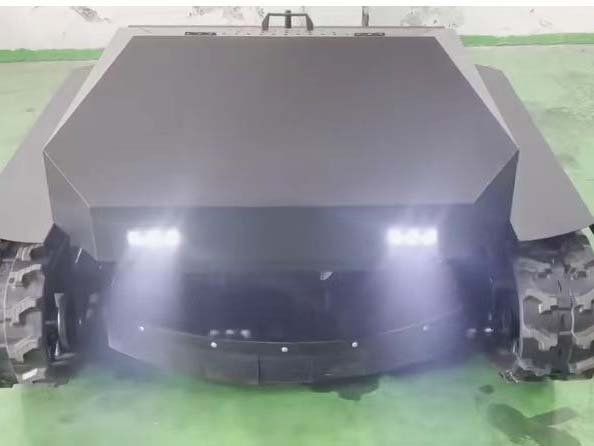
- LED headlights: not “any light will do”
Many mowers come with only a small tail light or a single work light with limited coverage. For night mowing, you need high‑brightness, wide‑angle, shock‑ and water‑resistant LED work lights.
Where to mount them
- Two main front lights – Mount on the roof or ROPS (rollover protective structure), one on each side. The beam should cover 3–5 meters ahead and also illuminate both edges of the cutting deck. Avoid a single light, which creates large shadow blind spots.
- Reverse light – Backing up at night is very dangerous. An extra LED reverse light lets you see obstacles or ditches behind you.
- Side auxiliary lights – If you often mow near trees or building edges, side lights help you judge distances.
What light specifications to look for
- Brightness – At least 1000 lumens per light. Anything dimmer is useless.
- Color temperature – Around 5000K (pure white) is closest to natural light and less tiring. Too yellow makes details blurry; too blue causes glare.
- Ingress protection – IP65 or higher – dust‑tight and protected against heavy rain (nighttime often brings dew or sudden showers).
- Beam pattern – Choose a “flood + spot” combination, giving you both distance and side coverage.
Remember: It’s not about making the light go as far as possible – it’s about clearly seeing the ground in front of your deck – rocks, holes, branches. That’s what matters.
- Reflective tape: being seen keeps you alive
One of the biggest threats at night isn’t that you can’t see others – it’s that others can’t see you. If you’re on a rental property or a farm with other people, vehicles, or even ATVs used for patrols, a low, wide mower can easily be overlooked.
Where to put reflective tape – high, wide, visible from all sides.
- Top of the roof or ROPS – Apply red‑and‑white striped reflective tape so people at a distance immediately spot “something there.”
- Sides of the machine – On fenders, around the deck edge – use yellow or orange reflective tape to mark the full width.
- Rear – At least two red reflectors, each no smaller than 10cm x 10cm.
- Back of the steering wheel or control panel – If the operator’s body blocks the view, add a small patch on the back of the console.
Also, the operator must wear a high‑visibility reflective vest. Don’t think it looks silly. When you get off to clear a clog or check the blades, that vest makes sure other equipment drivers see you. A vest costs only a few dollars – how much is your life worth?
- Safe night mowing practices (every rule comes from real lessons)
4.1Survey the area before dark
While it’s still light, walk or drive the entire lawn. Mark: large tree roots, manhole covers, sudden slope changes, irrigation heads, and scattered rocks. Use small flags or fluorescent spray paint. Then follow those markers when you mow at night.
4.2 Cut speed by at least 30% compared to daytime
At night you can’t see every detail, and your reaction time is longer. Reduce your mowing speed – especially when turning or approaching obstacles. Don’t try to save time. Better to mow one extra hour than to roll over once.
4.3 No fatigue operation
Limit night mowing to a maximum of three consecutive hours, then take a 15‑minute break. Signs of fatigue: you start zoning out, the lights seem dimmer (your eyes are tired), or you repeatedly run over things you shouldn’t. Stop immediately and finish the next day.
4.4 Mowing slopes at night? Generally forbidden
Unless the slope has fixed lighting strips, avoid any slope steeper than 10 degrees at night. Darkness makes slopes feel milder than they really are – you might think you’re on flat ground when you’re already leaning. If you absolutely must mow a slope at night, use a machine with ROPS and a seatbelt, and only go up and down – never across.
4.5Carry backup lighting and a communication device
If your main lights fail or a wire comes loose, you need a head‑mounted LED miner’s light or a powerful flashlight. Also keep your phone fully charged in a waterproof bag. If an accident happens at night, getting help is much harder than during the day.
4.6Use a two‑person system
If conditions allow, work with a partner: one operates the mower, the other follows at a safe distance in a pickup or UTV, using their headlights to supplement your lighting and acting as a safety observer. Many night accidents happen because no one discovers the victim in time. At a minimum, tell someone off‑site: “I’ll be mowing the east field and plan to finish by 11 p.m. – I’ll check in then.”
- Summary: night mowing isn’t about taking risks – it’s about managing them
Night mowing can be a real productivity booster, but it requires raising your safety standards to a higher level. LED headlights let you see the ground. Reflective tape lets others see you. Strict operating practices keep you from making mistakes.
A mower suitable for night work isn’t just a stock machine with a tiny bulb added. And a responsible night‑time mower isn’t someone who just “isn’t afraid.”
Next time you think about mowing after dark, ask yourself three questions:
- Can my lights clearly show rocks and holes within 5 meters?
- Can anyone approaching from any direction see me and my machine from 100 meters away?
- If I rolled over or got injured right now, would someone find me immediately?
If the answer to all three is “yes,” then start the engine. Night mowing – slow is fast, and safety is the ultimate productivity.
(Feel free to share your own night mowing experiences or lessons in the comments – let’s help others avoid mistakes.)
-300x76.png)